Walleye Spawn


The Walleye spawn was very tough this year. Large variations in temperature during the spawn I think led to a difficult bite. The fish that were caught were largely on Original Rapala's and White Grubs. I saw many Walleye, some of which were very large, close to shore but only caught a few. Hopefully, as the year progresses I will be able to catch a few more. Overall I was pretty disappointed with the results of this years spawn. Below is 2 1/2 lb Walleye, caught on an Original Rapala, black and silver. 


Wiper ID


With the Wiper Run about to start and a few fish sporadically being caught I thought I would take a moment to show how one can tell the difference between a White Bass, Wiper, and Striped Bass. In Clinton Lake and the majority of Kansas Reservoirs both White Bass and Wiper are present. The information below comes from http://www.kdwp.state.ks.us. I always encourage catch and release but especially with Wiper, which are naturally sterile and are only present due to stocking by Fish and Game Departments. In Kansas the limit on Wiper is two, there is no limit on White Bass. Hopes this help you identify your fish this year.


White River


The White River in Arkansas is one of the most famous trout rivers in the central US. A cold river tailwater, the White flows out of Bull Shoals Dam, at a consistent temperature in the high 30's - low 40's. This occurs because the dam pulls water out of the bottom of Bull Shoals lake, below the thermocline,  which can get as deep as 200 ft deep. Four different trout species exist in the river: Rainbow, Cutthroat, Brook, and Brown Trout, with the dominant species being Rainbow Trout. Most of these are in the 1 lb range and are mostly stocked, but for Bret and I the reason on heading down was monster Brown Trout. On a tributary of the White , the Little Red, the World Record Brown Trout of 40 lb 4 oz. was caught in 1992. It is not uncommon for Brown's to be caught in the 5-8 lb range and a few 20-30 lb fish are caught each year. We fished solely with fly gear and after 4 days of non-stop fly fishing I think we both came out much better fly anglers. On Saturday we fished with the Free State Fly Fishers, the local Lawrence Fly Club; Sunday we waded up and down the river by ourselves; Monday we fished with a guide Ron Yarborough, and Tuesday we went to the Spring River out of Mammoth Springs. It was a great trip, we caught a lot of fish, and Bret landed one really nice Brown. I would recommend the White to any angler. 


Bret and I, just before heading out on our first excursion into the river. 


Bret gets the first fish, Rainbow on a Zebra Midge.


Stan the Man! Saturday the fishing was really tough. Even the most experienced anglers in the club were  having a difficult time catching fish. That is except Stan, all day he was able to produce fish, over 30,  and ended the night with a Brown Trout. 


My first White River Trout, Rainbow on an Olive Wooly Bugger. 


Beautiful Morning View of the White River.


Replica of the World Record Brown Trout: 40 lb 4 oz.


Replica of the State Record Rainbow Trout, 19 lb 1 oz. White River 1981.


Bret Landing a Rainbow, Crackleback. 


Rainbow on a Green Wooly Bugger. 


Small midge patterns worked well all week. 


Green Soft Hackle


Another great looking rainbow from Bret.


Nice to see signs of spring, when we had snow in Lawrence last week.


Casting above some Ripples


Releasing a 2 lb Rainbow, caught on a Crackleback variation. One thing we noticed is that trout are deceptively small on camera. A 2 lb trout looks much smaller in a photo then say a 2 lb Largemouth.


First cast below the Dam, Bret catches an 8 lb Brown Trout, 24 inches, amazing fish Bret! Put up a great fight. Caught with guide Ron Yarborough from a boat. The water went up several feet during the night. Earlier that week Ron caught a Rainbow which released eggs once in the boat. This meant there could still be some Rainbow Trout spawning up near the dam so we tried an egg pattern to capitalize on this.


Fishing from Boat, below Bull Shoal Dam.


3 lb Rainbow, Zebra Midge.


Small but beautifully colored Rainbow


Bret lands another great fish, 4 lb Rainbow. San Juan Worm.


Okay, no where near the size of Brets Brown, but I still was able to catch my first Brown Trout on the White. Egg Pattern. 


My St. Croix #4 Avid. This was my primary rod on the trip.


Tuesday we left for home but stopped at Mammoth Springs to fish the Spring River. This is at its source. 


Bret wading the Spring River. Beautiful scenery. Unfortunately, we later learned from some guys at the Springfield that it is fished very heavily and few fish are released. We caught no trout that day.


Casting Line on the Spring River. May not have caught any trout but it was a beautiful river to wade on our last day.

Kansas Fishing Report


For anglers in Kansas, there exists a wonderful resource to see fishing conditions at various lakes and rivers across the state. The Kansas Fishing Report is published on Kansas Department of Wildlife and Parks website. Generally, it is updated weekly and gives not only the current report for each lake by species it also details the total outlook for the lake that year based upon sampling. The state is broken into five regions across Kansas. Lawrence and the surrounding area are located in region two. 

Check it out here: Kansas Fishing Report

First Fish of The Year!


The season has officially begun! I went out yesterday to go fishing and caught my first two fish: a 4 1/2 lb and 3 lb largemouth. Location: Secret and Undisclosed! They were caught on Strike King Series 6XD and 6 crankbaits respectively using a very slow retrieve. Not a bad way to start the season!


Great fish to start the season with! 4 1/2 lbs


The Strike King Series 6XD in Sexy Shad Color Pattern. This is the crankbait series that Kevin VanDam has won over $4.5 million in tournament winnings on. I really like the crankbaits thus far and how they designed them to hit all depths from a few feet to 17 feet depending on the series number.


The 3 lb Largemouth I caught on the Series 6 Citrus Shad Color Pattern. Here are the depths for the crankbaits in the series. Series 6XD 17ft, Series 6 15ft, Series 5 12ft, Series 4 8ft, Series 4S 5ft, Series 3 8ft, Series 1 2-5ft, Series 1XS 1ft, Series Mini 3 4-6 ft. You can see how these crankbaits really allow you to pinpoint the depth you want to achieve. Better yet they are cheap. I am sure I will be using these baits much more this year. I will keep you up to date, but so far I am very impressed. 

The Skinny on Fishing Line


In any fishing tackle store, walk into the fishing line aisle and you may be overwhelmed by the multitude presented to you. There are three main options when choosing line: line type--Braid, Monofilament, and Fluorocarbon; line weight; and line color. But line is line right, well not exactly. Often overlooked your line choice may be the difference between a great day and a few bites. Here is my take on line. I hope you learn something and hopefully your next trip to the tackle store will be a bit less of a headache.

Line weight is the most straightforward. Pick the lightest line weight possible for the environment and fish species in order to maximize casting distance and sensitivity. When I fish the spillway for Flathead Catfish I know that I am going to potentially catch a fish 60+ lbs and will also be fighting a very rocky bottom so I choose 80-100 lb line. If I am throwing beetlespinners to suspended Crappie I prefer 4-6 lb test. 

Line color is also simple. In murky water I prefer greens, in clear water I prefer clear line. Match the line color to the water color in order to minimize line visibility. 

Now to what confuses many anglers: line type. A few years ago almost all anglers used monofilament and it still remains the most popular choice today, however, in several circumstances and presentations there are better options. 

Monofilament

Monofilament was invented by the Dupont Chemical Company in 1939. It is quite simply a single strand of plastic of a certain diameter which gives it a tested breaking strength. Monofilament is cheap, has the slowest sink rate of the three line types, has the most stretch, excellent knot strength, is very manageable on all reel types, and is available in a multitude of colors and test weights. The primary disadvantage of mono is that it is highly subject to line twist and over time it becomes weakened by UV light and water absorption. Given these disadvantages most anglers change their monofilament lines at least once if not more often per fishing season. 

I prefer to use monofilament on most of my spinning reels given its low memory which makes it more manageble. Further given the slow sink rate, since it absorbs water, mono is an excellent choice for finesse fishing technique like wacky rigs, allowing the bait to suspend longer and drop slower when presented to the fish. 

Fluorocarbon 

Fluorocarbon or Polyvinylidene Fluoride, was first popularized as a leader material for saltwater applications in the 1970's and as the chemistry has advanced allowing for softer and cheaper production, fluorocarbon may now be used as a main line for a variety of fishing styles, not just as a leader or tippet. While it may look and somewhat feel like monofilament, fluorocarbon is a very different breed of line. The defining characteristics are its high abrasion resistance, fast sink rate, and low optical density. This last quality is what has attracted many anglers to it. Water has a light refraction index of 1.333, fluorocarbon refracts light at 1.41 whereas monofilament refracts light at 1.52. This means that fluorocarbon is much less visible under water, though not invisible as some manufactures claim, allowing  the angler to present the bait much more naturally. The density of fluorocarbon are also what give it its qualities of a fast sink rate and abrasion resistance. Unlike braid and mono, it does not absorb water and as such has the fastest sink rate of the three. This makes it very useful for deep water applications. Further this density allows the line to resist nicks from obstructions and the teeth of fish, in fact this property is what first popularized fluorocarbon as a leader material for toothy fish such as Barracuda and Muskie. 

There are certain disadvantages to fluorocarbon as well. First is the cost, a typical spool of line will cost anywhere from $14-30 dependent on the line quality and brand. Secondly is knot strength. The density of the line makes it susceptible to cracking when tying a knot. This can create a weak spot allowing the line to break upon hooking a fish. To avoid this, manufactures recommend lubricating the line first with water and using a palomar knot when tying on a lure. Finally, fluorocarbon is much stiffer than either mono or braid. This often makes it difficult to use on spinning reels, I will admit I have tried two different brands on spinning tackle both of which ended in frustration. 

I currently use fluorocarbon fully on only one rod. A pole which I have set up specifically for deep diving crankbaits. The reel is a baitcaster and I have had no problems with line management unlike on my spinning reels. The sink rate and abrasion resistance of the line allow me to achieve deeper depths and resist nicks from rocks or timber I may be bumping into. I also use it as my tippet on my #4 weight fly rod during trout season due to it low visability and plan on using it this year in the form of a leader during the walleye spawn again for visibility reasons. 

Braid

Braid is the oldest of the line types but is only recently making a comeback with modern anglers as increased material strength has allowed it to become much stronger as well as thinner. Braided line is made from man-made fibers such as Dacron, Spectra, and Micro-Dyneema which are woven together to make one line. Braided line has no memory, handles line twist very well, is very thin, has no strectch, and incredibly abrasion resistant. Braided line will work on both spinning and baitcasting reels, though its limpness will sometimes cause severe birds nests in both reel types. The two primary advantages are its abrasion resistance and thin diameter. The thin diameter allows for exceptional casting distance. For example Power Pro brand braid in 20 lb test is only .009" compared to 20 lb monofilament at .016". This allows not only for greater casting distance but also the ability to use heavy line on spools which would otherwise be to small to accommodate heavy test mono or fluorocarbon. The abrasion resistance and strength of braid is phenomenal. It is very difficult to cut without scissors or a knife, no using the pliers here. This translates into a line which is great when fishing heavy cover such as spillways or heavy timber. The final reason to consider line is the lack of stretch. If lures will be far away from the angler this will result in more solid hooksets. 

Braid also has many disadvantages. First is it is the most visible line type. Clear water applications or use with line shy species is very limited. Secondly, the small diameter causes a lure to fall through the water faster than it would on a similar test weight mono. While this may be desirable for some applications in others such as finesse fishing, it will prove a cumbersome inconvenience. Finally, as alluded to previously, the limpness of the line can cause bad birds nests, or knots in your line. A higher quality reel can prevent a lot of this but they are unavoidable from time to time. 

I primarily use braid when fishing for large, aggressive fish species: flathead catfish, muskie, and northern pike. These are active, aggressive feeders who quite honestly are not timid when it comes to line recognition. The small diameter allows me to cast further and the abrasion resistance gives me more confidence to cast into areas where I would otherwise lose my tackle. In murky water I also use braid to fish heavy timber for bass, when pitching jigs or spinnerbaits. The murky water I believe makes up for the line visibility. 

In summary, there are no absolute right line choices for all conditions and all anglers opinions will differ slightly. I hope I have at least illuminated the subject and also shown you why I have made my choices. Experiment will all three and learn the characteristics for each and I promise you will become a better angler. 


Fly Tying


This fall I started learning how to tie flies. I have been resisting for a while now, but finally succumbed to the inevitable. So far I have only learned how to tie two patterns: Wooly Bugger and Sarge's Crappie Fly but I am sure I will learn more patterns soon through the fly fishing club and a fly tying book Bret gave me.  My goal is to learn how to tie a Clouser Minnow by the time the Wiper Run begins in April on order to fish with only flies I have made. The obvious appeal to tying your own flies is that you are catching fish with something you have created from scratch rather than something you purchased at a store. 


First fly I ever made. Wooly Bugger. Fly Vise is a DanVise. I must admit not bad for the first fly... 


Coffey County


Last week I went to Coffey County Reservoir on a fishing trip. Coffey County is a cool-off lake for Wolf Creek Nuclear Power Plant. This makes a few things interesting. First of all to get on the lake you have to have your boat checked, livewell bleached, sign some papers, answer a few questions, and show identification. This is an effort to protect the power plant. First and foremost to prevent Zebra Mussels' from becoming introduced to the lake which could cost the plant millions in damages. Secondly, since 9/11 there is an awareness of potential attacks on Nuclear Power Plants and the lake wants to be certain of who is allowed to fish there. Secondly, once allowed on the water you must wear a life jacket at all times and are given a beeper that can call you off the lake should you violate the rules or the current becomes too swift. Finally, the water coming off the plant is hot, really hot. We fished the outlet for a moment and were still relatively far away and the water temp was still well into the 90's. As far as the power plant itself. It was far smaller than I expected. You can see a pic in the above left, and it looks more like an Observatory than a Nuclear Station. Despite the fact that the lake has a nuclear powerplant on it. It doesn't serve as a tremendous eye sore like the powerplant on La Cygne in that you cannot see it from most locations on the lake and the rest of the lake may be some of the most beautiful water I have fished in Kansas. 

Coffey County has a reputation as being an excellent fishery year round, due to the high water temps and is also known as Kansas's best Smallmouth destination. I have wanted to fish it for some time and while we didn't do as well as I would have hoped it was still enjoyable, surrounded by surprisingly beautiful terrain, and if nothing else provided a few stories. I had a great time and would love to fish it in November or March to take advantage of the warm water. First time anywhere is spent largely learning the water. For the day we caught three Largemouth, one Wiper, one White Bass, one Smallmouth, and one Drum. We will forget about the drum... also I had two fish break my line. For the time being I am going to running braid on my pole I use for wacky rigging. Here are the pictures: 


3 lb Wiper caught on Sebile Crankbait. 


The north shore line provides excellent cover for Largemouth fishing. The two fish that broke my line were caught around this area. 


2 lb Largemouth from Tri. Wacky Worm. 


As noted, a beautiful lake to fish. 


2 1/2 lb Smallmouth. Caught on Grub. 

Two Bass


Several weeks ago I went to La Cygne to fish for the first time. I have to admit its kind of a creepy place at night and the power plant is less than scenic. Went there for flathead but all of our bluegill died en route so we tried for channel catfish with no luck. Being 3 AM I started messing around with a chartreuse spinnerbait and to be honest accidently caught two largemouth. Biggest was 3 1/2 lbs. 


A few days later I took a friend fishing from work who hadn't fished in years. It was an interesting experience he caught one bullfrog and a bluegill. To his credit the wind was very severe and casting was difficult. I caught six largemouth including my biggest yet of the year a touch over 5 lbs caught on a crankbait. Was quite a fight, he was not cooperative coming in. 


Reed Memorial


Reed Memorial is a nature reserve located a few miles south of Lee Summit, Missouri. Over 3,000 acres of trails, woodland, prairie, and twelve fishing lakes. Ten of these lakes are open to the general public, one is a kids only pond, and the other is open only by reservation for groups. Catfish, Largemouth Bass and Trout populations are all good, with Crappie, Panfish, and Wiper present as well. Pond size ranges from the one acre kids ponds up to 42 acres, all are easily accessible.  See link below for a map of Reed Memorial Wildlife Area:


Yesterday was my second trip to Reed Memorial. We fished three lakes: Bodarc, Bluestem, and Catclaw. Between the three of us we caught 11 Largemouth Bass, with the largest being 4 1/2 lbs. Fishing was tough and reliant completely on finesse techniques: fishing near structure and shade, but from what we saw and heard from others we were wildly successful. Give it a few weeks to allow for cooler weather and it should be hot with much more active fish. Overall it has loads of potential, the rumor of 8-9 lb Largemouth and 10 lb Wiper, and is very scenic. If you live in the KC area and fish, Reed Memorial needs to be on you list of spots to hit this fall.  Here are the pictures: 


View of Bodarc Lake


Bret Wacky Rigging.


Derek's first fish of the day, a monster largemouth. I have to give him a hard time for this small one because he caught 6 of the 11 bass that day. 


Structure and shade were the keys.


Fantastic 4 1/2 lb largemouth caught by Derek. Wacky Rig. 

Frog


Bret and I were messing around at the pond the other day for a half hour or so and came up with an interesting catch. While retrieving his worm, a large bullfrog decided that plastic worm was on the menu for the day and soon enough ended up on the end of a hook. Worry not, we were able to get him off easily enough but it was still unexpected. 


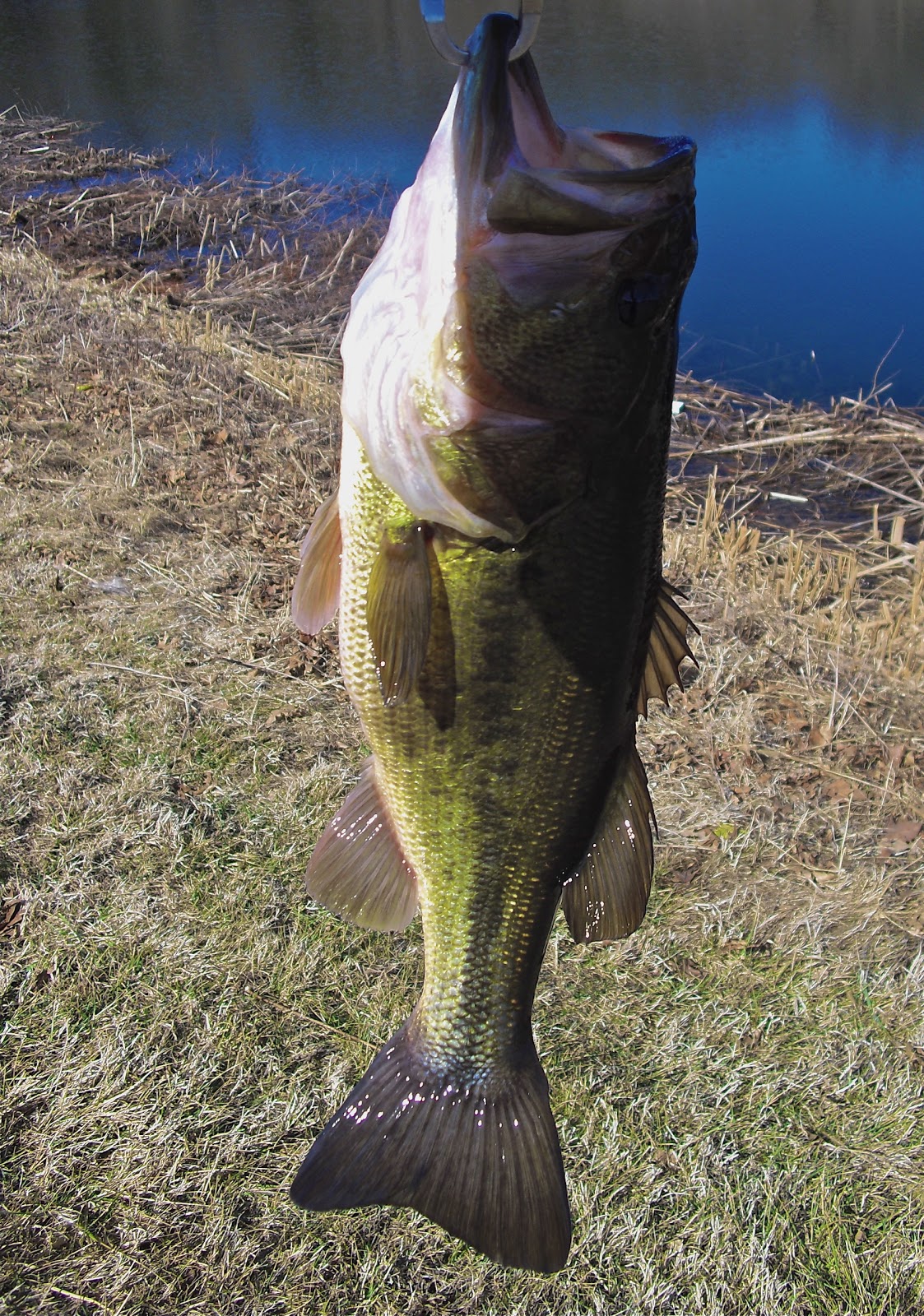
We also caught a largemouth each. No Boga Grip so not sure on weight. At the moment I am only able to upload the picture of my fish due to technical issues but we will try and get Bret's fish up soon.