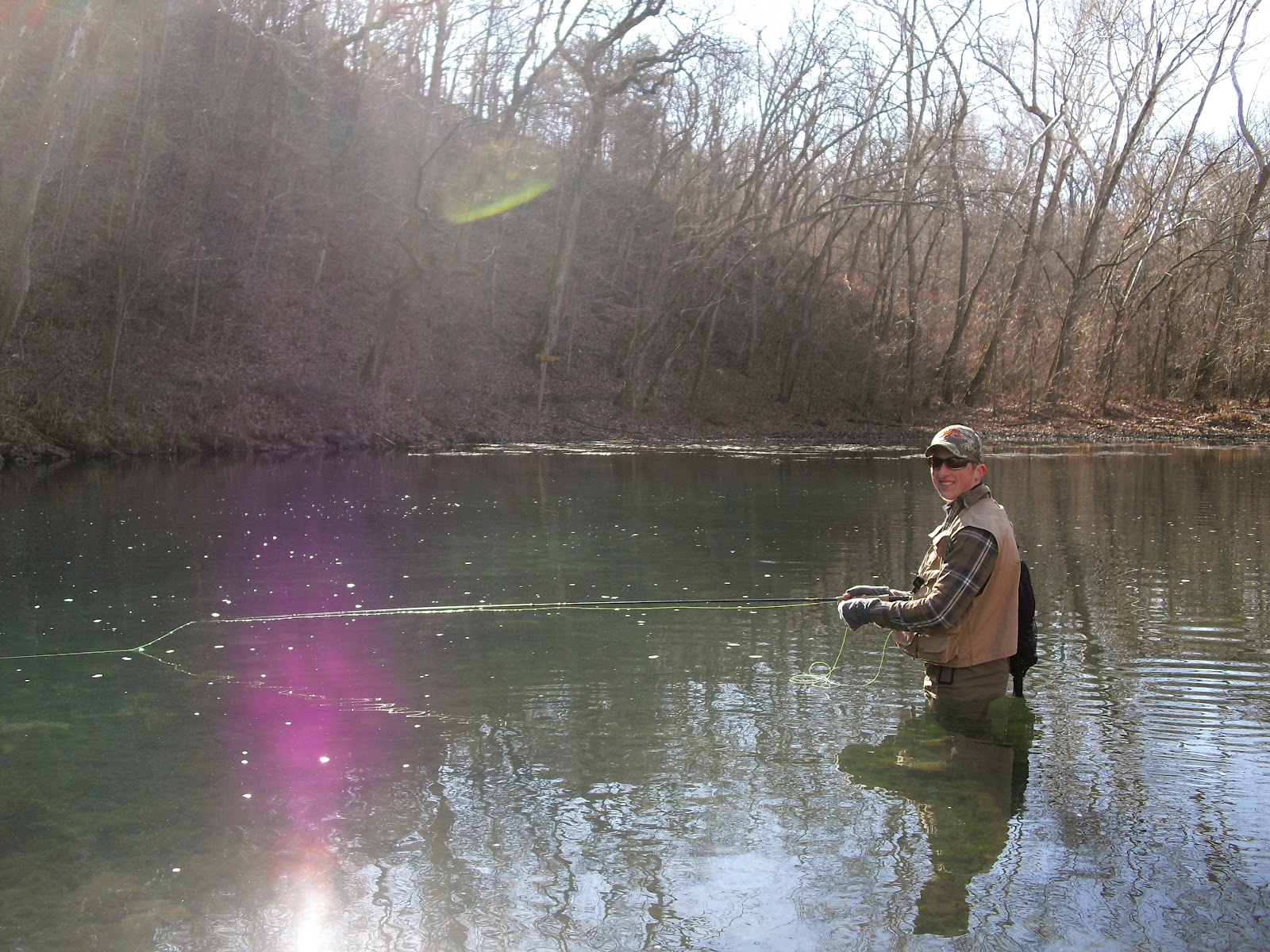
Driftless March 2012


Sorry for the delay on this guys. The joys of being a graduate student. I have been completely swamped with school work since returning from spring break. Thank goodness summer is in one week. Anyhow I hope you all enjoy this severely overdue report from the Driftless.

After Hazel Creek, Bret and I headed to Marshalltown Iowa to stay the night with my parents before heading up north. It was a welcome stop as it allowed a severely burnt Bret a chance to get some Aloe Vera and we were able to watch a scary but enjoyable KU v. Purdue game. Thank god the Jayhawks won, however slightly. 

I had only one hour of sleep the previous night so the first day we took advantage of a chance to sleep in, and got off to somewhat of a late start. Our destination and where we would be staying was Decorah, IA, but due to threats of storms and rain we augmented our initial plan to head straight for the Waterloo River, and instead decided to fish some of the stocked streams on the way up. Our first stop was Glovers Stream just outside of West Union. Located in a beautiful little valley and stocked with Rainbow's, Bret, my father, and I set up to start the trip right. The water however was pretty skinny, inches in most places, so where the fish were concentrated they tended to be fairly skittish. Bret did see his first wild Bald Eagle, which would be a sign of the 4 others we would see during the trip and I did manage a Rainbow on a size 26 black midge right before we left. Having fished Glovers for a few hours with limited success we continued north to Decorah. With daylight closing in we decided on Twin Springs within Decorah itself as our second and final destination for the first day. Fish were pretty sparse and few between in the spring but Bret did manage one at the Spring head on a Hare's Ear. 


Glovers Stream, West Union IA


Little Bow' caught on Black Midge under an Elk Hair Caddis. 


Twin Springs, Decorah IA. 


Bret's Rainbow on a Hares Ear. 

Day two we woke up bright and early and went to the catch and release area of the Waterloo river south of Dorchester. When we arrived we had a light rain and a heavy fog which only added to the mystique of this gem of a stream. We saw fish rising initially but were unable to fool them into any of our dry flies. The water was much deeper here so we all tied on wooly buggers and Bret managed two nice wild Brown's on an orange wooly bugger. We also saw an eagle's nest inhabited by two bald eagles. 


Bret throwing an Adam's to rising trout on the Waterloo. 


Waterloo Brown, Orange Wooly Bugger. 


Bald Eagle


My father trying to persuade some Brown's, nestled against the timber, to take his fly. 


Such beautiful country. 


Bret's second Waterloo Brown, Orange Wooly Bugger.

After my father left to go see my Great Aunt for her birthday, Bret and I headed off in pursuit of some new streams. First we tried Pine Creek, noted in the stream guide for holding wild Brooks, unfortunately we only saw one fish the entire time we walked it, so we left and went to the North Bear. The North Bear proved to be very productive and allowed me to finally knock the skunk off myself for the day. I caught five Browns and a Brook all on size 24 Brassie's. Bret also pulled a gorgeous Brook on a Zebra Midge. 


Though we didn't catch any fish at Pine Creek I did find a friend. Common Garter Snake, Thamnophis sirtalis. 


Finally, a Brown. 


Good to see, a healthy young population. Caught two this size. 


A beautiful Brook, caught by Bret. Zebra Midge. It was nice that Bret and I all caught the three species of trout represented in the Drifless during the trip. Next time, aiming for all three in one day. 


My second North Bear Brown. Brassie. 


Bret throwing in the North Bear. 


First Brook Trout of my life. 3/4 lb. Brassie. 


Some ripples just north of where Bret caught his Brook. 


Last Brown of the day, still caught on the North Bear but at an access point north. 

The last day we fished the French for most of the day. The French may be one of the most beautiful, pristine streams I have ever fished. It only contains wild Brooks and Browns. Catch and release only as well as only limited to artificial lures. The density of trout we saw was crazy and they were incredibly beautiful. We fished it for hours, but no hook ups. The fish were very spookish and at some times if you didn't crawl to the streams edge you would scare them all away. Regardless, it felt like an honor to fish there and didn't upset me at all to get beaten by such a beautiful area. 

After the French Creek, we went back to the Waterloo, found a bunch of Carp, though they were in spawn and not too interested in our flies. Bret did have a brief hook up with one, but it got off. We fished down stream for a bit and I finished the day by catching one Brown on a Zebra Midge. 


French Creek with Beaver dam. 


As you can tell the water is crystal clear at French Creek. Trout density is 2500 per square mile according to the Iowa DNR. Getting one to take the fly is another game in itself. 


Close up of an Adam's Dry, set up with an unpictured midge as a trailer. 


Hard to believe this is Iowa. 


Bret fishing the Waterloo. 


Until next time. 

Hazel Creek


On our way up to the Driftless in Iowa, Bret and I stopped at Hazel Creek reservoir near Kirksville Missouri to fish. Hazel Creek is unique in that it is one of four lakes in Missouri that are stocked with Muskellunge, the others being: Pomme de Terre, Fellows Lake, and Lake 35 in the Busch Conservation Area. Of those Hazel Creek has the highest rating for catch rate with the average angler catching a Muskie every 16 hours vs. 40 hour average on the other lakes. The average size is 32-36". 

The lake was pretty windy and we took on a bit of water in the Kayak but nothing too bad. What we had to decide was how to pattern Muskie on a lack which lacked vegetation. We tried trolling, casting off deep points, and fishing near fallen timber. Though we never hooked into any teeth. We did land four Largemouth Bass however, one by me and three from Bret. And the lake has a great reputation for Largemouth Bass, with 5-9 lb fish being reported as common. 

The only downside was I lost my favorite conventional pole which killed my mood and my desire to fish, which caused us two hours of searching for it with no avail. I was pretty pissed. Overall though, it was a very pretty lake and I would certainty fish it again. 

When we were leaving we talked to a good ole' boy who fishes the lake regularly and he commented that to catch Muskie there you just fish for Bass and you will catch Muskie incidentally. Good tip for next time. Stay tuned as I will have the post up for the Driftless soon, it was a lot of fun. 


Bret with a 3 lb Largemouth, Spinnerbait. 


Key West


Last week I went to Key West to join my family for a much needed vacation and partake in some flats fishing. The weather was beautiful, water was warm, and the scenery phenomenal. Now back in dreary Kansas I can only hope to return soon.

I had a great time. I was able to catch my first saltwater fish, had opportunities for several species, and learned a lot. I fished both on my own and with guide Captain Mike Bartlett. I have linked both his guiding page and blog through this website.


Thursday began my time spent on the water. I teamed up with Mike and headed towards some flats south of Key West. Not long after arriving we spotted a trio of Blacktip Sharks, one of which was super hot on some baitfish. Mike asked if I wanted to go after them and of course I said yes. I threw a tube to them but just as quickly as the action started it seemed to end and the sharks were gone. Had I caught one I am sure I would have shit myself. 

Next we proceeded to another flat in search of Bonefish and Permit. Not too much going on there, and we never did see any bonefish the entire trip and would only see one Permit that day, which was headed 30 mph in the opposite direction. 
We hit one more flat before we needed to go pickup my father so he could join us. There I got the opportunity to throw several flies at Bonnethead Sharks, but my inexperience as a saltwater fly angler shown through and I am certain I made almost every mistake I could. 

After we picked up my father we decided to chase Jacks on Ray's. Meaning Jack Crevalles were holding tight to Sting Ray's as they fed on the flats hoping for an opportunistic meal. What Mike would do was search the water for evidence of a mud, or feeding sting ray and then my father and I would throw a fly at the Ray hoping the accompanying Jack would snatch up the fly. Unfortunately for us, clouds made the visibility poor and the majority of Sting Ray's were without Jacks. I did hook into one Jack briefly but lost him as he charged the boat, dislodging the fly. 

We ended the day looking for Tarpon, but the spot we tried was inhabited by a pod of Dolphins who most likely discouraged the presence of any resident Tarpon. 

The next morning headed to Bahia Honda State Park to wade fish, a place a friend of mine had hooked into a Permit and I had heard stories of Bonefish. As a novice flats angler, and not knowing what to expect, I tied on a small Clouser and headed off looking for fish. Unfortunately, the only fish I saw were small groups of Needlefish, which I always saw too late and made desperate cast towards.


My respect for flats fishing by wading greatly increased that morning. Wading knee to waist deep, your visibility is greatly reduced and as your sight fishing stealth and awareness are keen. However, the scenery was great and water warm, so no complaints from me. Further I did see some crabs and even a pufferfish on my walk back to the beach. 

That evening I headed to White Pier in Key West itself. Talking to an employee at the Saltwater Angler Fly Shop in Key West I learned that often Snook and Tarpon would inhabit that waters at night, hunting the baitfish which were attracted to the light. I did see several large Snook and a small Tarpon but couldn't get anything to commit to the various flies I presented.


Saturday morning I went back out with Mike, hoping to wipe the skunk off my previous attempts. We first went to a very shallow flat looking for Redfish feeding on Mullet. We saw a few Redfish but they were all headed away from the boat rather quickly, but I still made a few casts. In the same area I did get another opportunity to throw a fly at Bonnethead's'. I didnt make the mistakes I made the previous day, but set my hook by lifting on the rod rather than punching the line. I had the fish on for maybe 20 seconds before he got off.


Mike and I then headed in search of Tarpon laying up in the flats. Difficult to see at first, the Tarpon looked like sedentary logs through the water. Mike estimated they were around 80 or so lbs. I was able to cast with a fly to two of them, but my accuracy wasn't as precise with an 11 weight as I would have hoped and the Tarpon didn't seem too interested. 


We then proceeded to the next flat in search of Barracuda and a change of luck. We saw quite a few and they were easy to spot in the crystal clear water and light sand. The first fish I cast into I was able to connect with. Finally! I hooked into him with a yellow tube on spinning gear and to my surprise he took off beyond my field of vision. I couldn't believe how fast my line left the spool or how fast he was. It was beyond my expectations of how a saltwater fish would fight. I am fairly certain I let out a few excited utterances. The fight didn't last too long but its intensity and speed were unmatched by any fish I have ever encountered. He even jumped for me. 


The sound of ones drag is by far one of the sexiest sounds for any angler.


20 lb. Great Barracuda. 


Look at those teeth!


Given my love for Muskellunge, I couldn't help but think of them when I caught this guy. 


Mike with the release. 

You can't imagine how relieved Mike and I were to finally have the skunk off me. This was my fourth outing throwing line in Key West and second time out with Mike. It was great to finally have that line tight. I threw to a few other Barracudas  in around the area without success and then decided to move to another location that would be more promising for permit and Tarpon. 


This is where I have to give Mike a lot of credit. In a flats situation, you have to listen and trust you guide. With their experience and vantage point they can see and detect fish much better than you. Mike called out Permit at my 12, seventy-five feet or so. I couldn't really see anything but made a cast right to that spot and almost instantaneously the line took off. My main remark is that my respect for Permit quadrupled. They are strong and give a long and thorough fight. He came several times to the boat before taking of again. Permit as a species gained enormous respect and admiration from me that day: for their fight, beauty, and the skill required to catch them. 


My very first Black-Tailed Devil. 15 lb Permit. I was truly surprised how beautiful it was. 


Soon after, I spotted Tarpon rolling in the distance. I had seen videos of this, but in person it was extraordinary. The closest similarity I can think of is to Dolphins. By the time we got to where they were positioned they were too deep to go after on a fly rod so I threw on a swimbait and made a few casts. The line went tight, but not too tight.... I hadn't caught a Tarpon but instead a tiny Jack Crevalle. The same species we had been targeting earlier on the backs of Stingray's. This guy was just a runt compared however. 


Well, that was my fishing experience in Key West. Honestly, it was amazing. I was able to cast to Redfish, Needlefish, Permit, Bonnethead Sharks, Blacktip Sharks, Tarpon, Jacks, and Barracuda. Granted I only caught three fish and none on a fly rod, yet honestly it didn't matter. I learned so much, believe I came back a more proficient caster. Yet, most importantly was the experience, the beautiful scenery, and memories for a lifetime. 

Finally, for anyone headed to Key West  I would highly recommend Mike Bartlett. He was great, very patient as I learned the ropes--especially on a fly rod, was able to effectively get me with my range, and was great company. Again for those interested I have posted links on my blog if you want to contact him. 

Blog of Interest


A gentleman named Steve Wozniak has spent the past few years traveling in a quest to catch 1000 different fish species. The first time I heard about him was in early 2010, in a report by the IGFA, as he was nearing 900. Two years later he has surpassed a thousand fish and last time I checked he was at #1094. His new goal is 2000.

I love to check into his blog here and there as I am always delighted. Its an angling pursuit that seems rare, to document accurately how many fish species you have caught and specifically target new species rather than trying to catch the largest. Some of the pictures do show large fish, many however are only several inches.

If your interested I have posted a link here and will repost it permanently under my fishing blogs section.
1000 Fish Blog

Just out of curiosity I created a list of my species list. I was disappointed as it is far smaller than I would have liked, as avid an angler as I am. My list was 21....

Now granted, there are fish that I did not count. I know I have caught several bullhead for example, but I am clueless as to which species and so I didn't count them, or for example I vaguely remember catching an eel when I was young, though the memory is so faint and I was so young it very well could have been a gar.

So as a side angling project I would like to expand my own list. Taking care to accurately record and document the species. At the top of my list are ones which should be easy in Kansas: Blue Catfish, Warmouth, Sauger, Longear Sunfish, and Black Bullhead.

Bennet Spring: Disappointment


A week and a half ago, Bret and I made the trek through the Ozarks to Bennet Spring. Having heard so much about this trout fishery, accompanied with tempting weather, we had to check it out ourselves. 

First we saw the trout hatchery itself, this is impressive to say the least. If you ever visit Bennet be sure to walk up and down the hatchery. I have never seen so many fish in my life. Thousands of trout ranging from a few inches to a few pushing several pounds. 


Yes, those are all trout. 


After seeing the hatchery, Bret and I hit the water, choosing the least populated spot we could find. There were a ton of people, far too many for my standards, and at an estimated 8000 trout per square mile we didn't think we could go too wrong in choosing a location with less people. The spring itself is gorgeous and the surrounding scenery is quite nice as well. 

That said, the fishing was poor. We saw very few bent rods throughout the morning. Trout after trout looked at our flies, only to turn away inches after inspecting them. All seemed most interested in the initial fall of the fly more than the drift, a trait I believe I came to understand earlier. 


After migrating downstream, we saw a group of guys slaying fish on fly rods. Upon closer inspection we learned they were using glo balls--repeatedly hitting the water, creating a splash, then picking it up seconds later to repeat. These guys easily could have been having 100+ fish days. Finding it much to crowded at that spot we went a few yards upstream. Bret put on a glow ball and I a green hares ear. Bret imitated the pattern we observed and immediately hooked in to a trout. I hooked into one on my hares ear, but had to horse it to prevent it from crossing the lines of the 25+ people not far downstream. Not that they didn't mind crossing my line repeatedly and hanging me up.  That said I lost the fish. 

This is when we began to notice something. Pellets--everywhere. Lining the banks on the bottom of the spring were pellets. These fish were gorging themselves just as they were raised in the hatchery, and the repeated splashing of glow balls tricked these fish into a feeding response. 

Finding it too crowded and with me passing borderline angry at the disrespect shown by fellow anglers we headed to our original location. Both Bret and I tied on Chamois pattern onto our lines and were able to hook into a fish each. Even here though we were only able to get fish interested by dragging the fly along the bottom and noticed pellets everywhere--which we hadn't previously noticed. I believe this explained, in part, why the fish were so interested in the initial fall of the fly, they were checking to see if it was a pellet. 

Overall, Bret and I left with a distasteful experience of Bennet. There were too many people for comfort, which was heightened by their lack of courtesy, and the fact that the fish seemed interested only in pellets and that this could provide so productive compared to traditional patterns annoyed me. 

Now I am far from a trout snob, in fact I am a trout newbie all things considering. I have nothing wrong with stocking trout and am not even willing to participate in the wild v. stocked debate. Given the number of anglers on the water, in some fisheries stocking is required, and I do not have a problem with that. My main issue was the pellets lining the stream. On other stocked waters, the trout have to naturalize quickly in order to survive, resorting to insects and fish as sources of food. Here it remained pellets. I view fishing not as a means to put fish on my table or even to see how many fish I can catch. While no one wants to be skunked, the experience is far more important to me, in other words those moments when you don't have a bent rod. Bennet just seemed unsporting.  

Now I know and have talked to anglers who have fished Bennet and had fantastic dry fly action, or great success on other patterns. I know there are several members from the club which frequent Bennet and I am not one to judge others. Perhaps my experience was an anomaly. However, given the drive and my ever expanding list of waters to explore I do not expect nor desire to return anytime soon. 


First fish of the year, Rainbow Trout, Chamois Fly. 

Year in Review


It was a good year of angling for me this year. I learned a lot of new skills, caught a few new species of fish, and honed in the skills I already have. I purchased my first boat, my kayak, which I still baby and love. And I was able to fish a lot of new water. More importantly it is the experiences shared with nature, friends, and family that I cherish most. Ultimately that is what fishing is about--the process. It's tying the knots, reading the water, putting down your rod to observe a sunset, jokes with friends, dreaming of tight lines, countless hours researching and studying technique, and that constant itch be on the water. I love to fish and I am incredibly passionate about it. 

New water I fished included: the Driftless in Iowa, the White River in Arkansas, Milford and Kingman in Kansas. Kingman still leaves a dirty taste in my mouth as it got the better of me in my pursuit of esox, but I will be back in early spring of this year to renew my pursuit of teeth. Location-wise my only regret is that this year is the first in several where I didn't make a trip up north to Minnesota. Minnesota will always be a special place for me: its where I learned to fish, where vegetation in lakes is the rule rather than exception, and where those species nearest to my heart (Pike, Muskellunge, Smallmouth, and Walleye) are most prominent. Hopefully this year!

I also caught several new species this year. First Brown Trout(s) ever and first Rainbow's on a fly rod. Caught my first Carp and gained a whole new respect for this often overlooked species, and on the rough fish side I also caught my first Gar (Shortnose) and first Smallmouth Buffalo (14lbs, biggest fish of the year). 

My home water remains Clinton, and while there are far better fisheries in the state, I always enjoy my time spent there. My guilty pleasure remains my honey hole pond, chalk-full of 2-5 lb largemouth bass. 

It was a great year, here's to the expectation and hope that 2012 will be an even more productive year of angling.